

Melbourne researchers urge tax reform to boost BTR housing
Tue, 20th Oct 2026 (Today)
University of Melbourne researchers have called for tax, finance and planning reforms to expand build-to-rent housing and modular construction in Australia. The findings were commissioned by property developer Freecity.
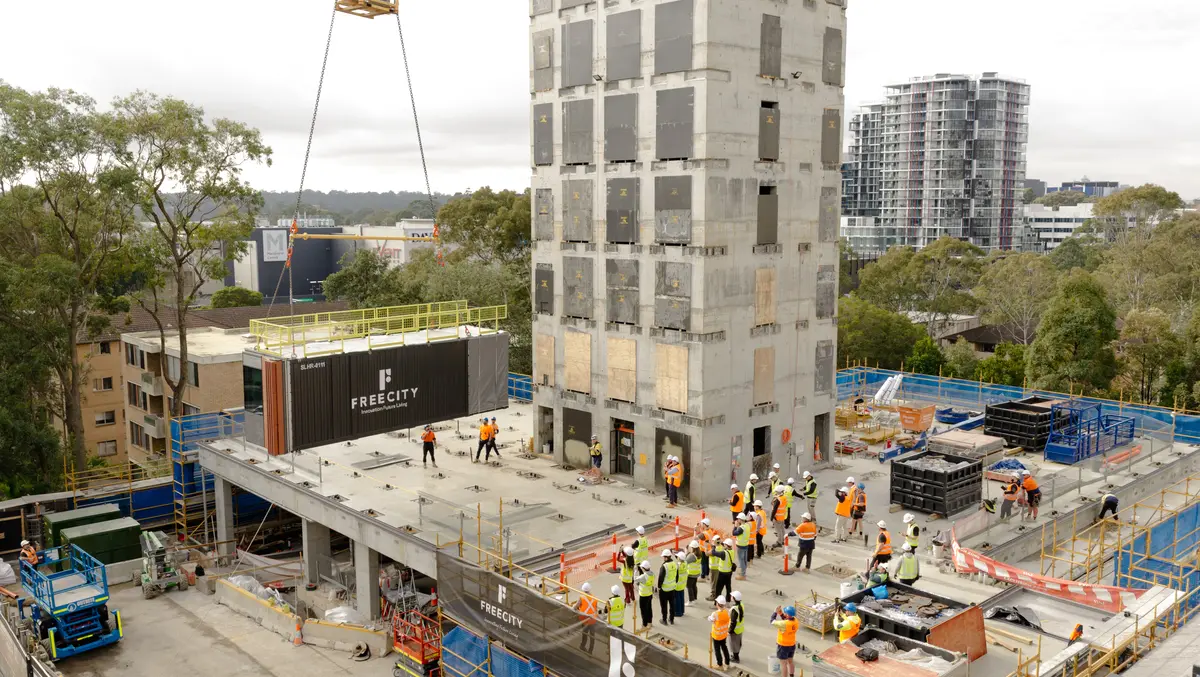
The report argues that current settings are limiting the use of Build-to-Rent and Volumetric Modular Construction, in which apartments are manufactured and fitted out in a factory before being installed on site. Comparing Australia with the United Kingdom, Canada, Singapore and the United States, it concludes those markets have created more supportive conditions for both housing models.
Researchers said combining Build-to-Rent, often known as BTR, with volumetric modular construction could help address slow housing delivery and rising building costs. BTR schemes typically involve repeated apartment designs and a single long-term owner, which the report says makes them well suited to factory-based construction methods.
The study found that volumetric modular construction can cut construction timelines by 25 to 50 per cent. It also found Australia's BTR sector remains small, representing 0.2 per cent of the country's residential market value, compared with 5.4 per cent in the UK and 12.0 per cent in the US.
The report comes as new BTR construction starts have stalled. Apartment construction costs have risen by about 80 per cent over the past decade, from $2,500 to $4,500 per square metre. More than 26,500 BTR apartments approved since 2023 have not yet started construction, equivalent to 64 per cent of the approved pipeline.
Six barriers
The research identifies six areas where existing rules work against BTR, modular construction, or both: tax, finance, incentives for modular construction, planning, certification and insurance, and logistics.
One of the central proposals focuses on GST treatment. The report says developers building apartments for sale can pass GST on to buyers, while operators of hotels or serviced apartments can reclaim it. By contrast, BTR owners cannot recover the tax because residential rent is input-taxed, leaving the full 10 per cent as an unrecoverable cost.
Researchers pointed to overseas examples. Canada removed GST from new purpose-built rental housing through a full rebate, while the UK applies a zero VAT rate to the construction of new homes.
Other recommendations include a national certification scheme for modular buildings, a legal definition of BTR in state planning systems where one does not yet exist, design guidance for modular BTR projects, a government incentive program, and a review of investment pathways for Australian institutional investors, including superannuation funds.
Steven Mann, Chief Strategy Officer at Freecity, said the sector was still at an early stage in Australia despite being established elsewhere.
"It's rare for a country to have the chance to grow a new type of housing. BTR is already one of the largest property investment markets in the world and Australia only started delivering it this decade. We believe modular BTR is well suited to delivering high-quality rental homes in large numbers and if Australia can match the growth rates of the US and the UK, it could be delivering more than 10,000 homes per annum by the next decade," Mann said.
He also linked housing supply to wider economic concerns.
"The Government's latest Intergenerational Report makes clear that housing is now one of the biggest drivers of inequality between generations, while lifting productivity will be critical to future living standards. Increasing housing supply and finding faster, more productive ways to build it has never been more important," Mann said.
Overseas lessons
The report says larger BTR sectors abroad have not undermined home ownership rates. Instead, it argues the model addresses a gap in rental supply created by demographic change and sustained demand for long-term rental stock.
Lead author Dr Xiao Ma of the University of Melbourne said governments in other markets had created enough certainty for investors and developers to proceed with projects.
"Modular construction is well proven overseas. In the countries we studied, BTR and modular construction grew quickly where governments provided pipeline certainty through enabling policies such as tax, government-backed finance, planning recognition or guaranteed demand on public land. Most of the barriers we found in Australia hit at the very start of a development, for example financing, planning and design, when investors are deciding whether a project is viable," Ma said.
The findings come as developers and investors look for ways to improve project viability amid higher interest rates, construction inflation and tighter financing conditions. For modular construction in particular, the report suggests clearer certification rules and logistics planning would reduce risk in the early stages of development.
Freecity funded the research as it develops a pipeline of residential projects using volumetric modular construction. Its current projects include a 528-room purpose-built student accommodation scheme at Herring Road in Macquarie Park, a proposed VMC-BTR tower in Parramatta, and two approved residential VMC-BTR towers at Rouse Hill that would deliver 548 rental homes.
Together, those schemes show how developers are testing modular construction at larger scale even as the wider BTR market remains constrained by policy and investment settings. The report concludes that Australia has the tools to expand rental housing delivery, but progress will depend on whether governments and investors remove barriers at the start of the development process.